HIVECUBATOR
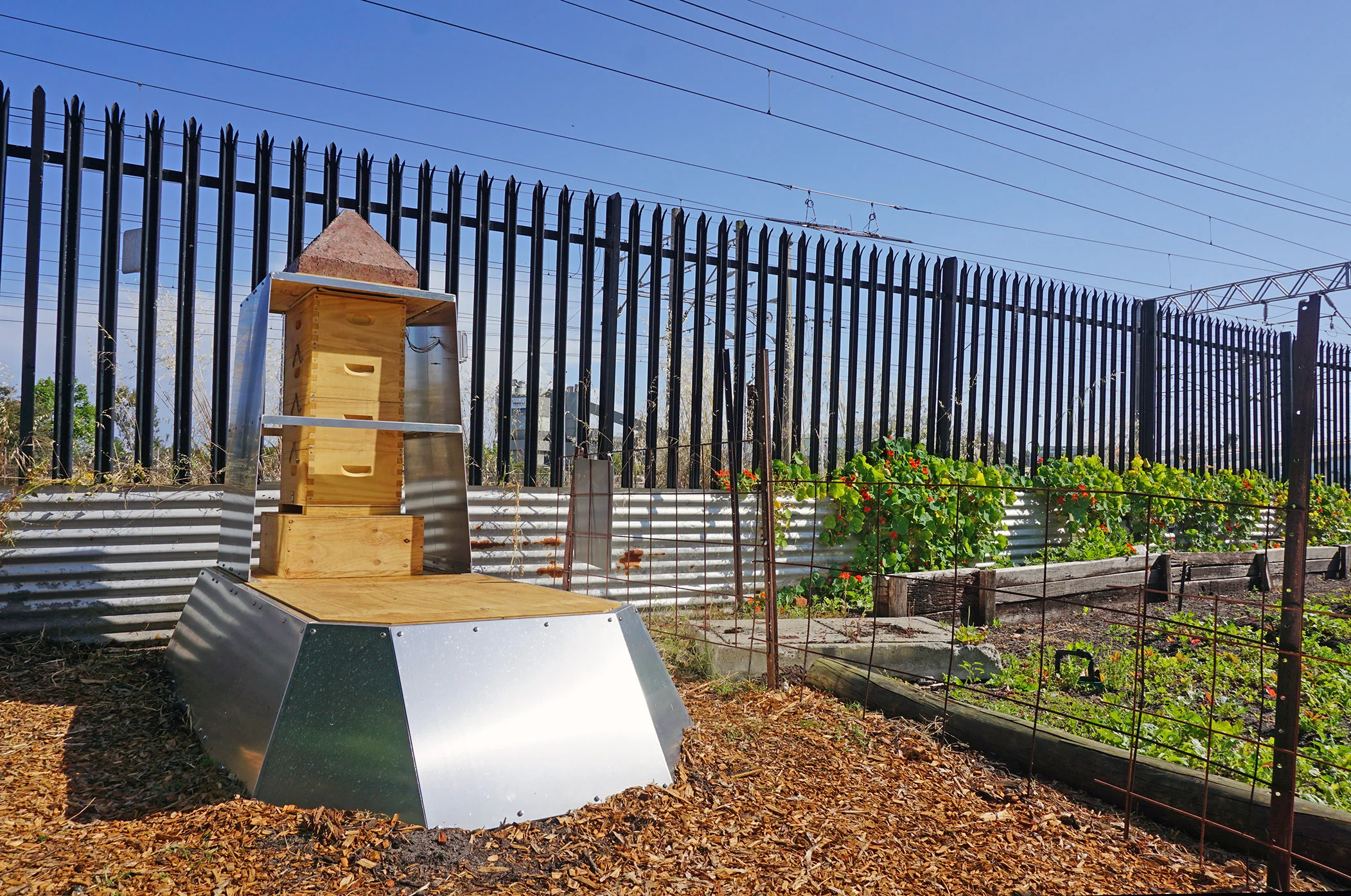
Hivecubator was a bioart research project that explored the ancient relationship between humans and honeybees through the contemporary technologies of tissue culture. The project developed a hive-based biological incubator in which the environmental conditions collectively produced by a living honeybee colony were used to support human cells growing in vitro. Drawing upon the hive’s capacity to generate heat and regulate its internal atmosphere, Hivecubator reimagined a biological function of the colony as an alternative form of laboratory infrastructure.
The project inverted the conventional relationship between beekeeper and hive. Rather than humans maintaining environmental conditions for honeybees, the colony was enlisted in maintaining the conditions necessary for human cellular life. This reversal became a means of examining interspecies dependency, care, control, and domestication at a cellular scale. Developed in the context of global honeybee population decline, Hivecubator asked what it might mean for human life to become materially dependent upon the collective labour of another species whose survival was itself increasingly shaped by human activity.
The physical form of Hivecubator drew upon the ancient Egyptian Temple of the Sun, associated with one of the earliest known representations of organised beekeeping. By bringing this history into contact with contemporary biotechnology, the work connected thousands of years of human–honeybee relations with emerging possibilities for manipulating and sustaining life outside the body.
Hivecubator 1.0 was developed in dialogue with Tissue Culture & Art Project (Oron Catts and Ionat Zurr) and their Compostcubator, and the works were exhibited in the Bioart Pavilion of the 2016 Kenpoku Art Festival in Ibaraki, Japan. Hivecubator 2.0 was subsequently commissioned by International Art Space for Know Thy Neighbour, curated by Katherine Wilkinson, and first exhibited at Perth City Farm.
The research later travelled internationally to Science Gallery London, where Hivecubator 2.0 was included in SPARE PARTS, curated by Stephanie Delcroix. In collaboration with the Centre for Stem Cells & Regenerative Medicine at King’s College London, the hive-based incubator was used to culture primary human keratinocytes. The experiment moved Hivecubator beyond a speculative model: living human cells were placed into a system in which their environmental conditions were supported, in part, by the metabolic and collective activity of a honeybee colony.
Across its iterations, Hivecubator brought beekeeping, biotechnology, architecture, and living systems into a single experimental structure. The work considered the hive not simply as a metaphor for collective life, but as a functioning biological technology, asking how relationships of care and dependency might be reconsidered when the maintenance of human life was placed—quite literally—in the care of another species.